Subscription brands run on different maths to one-time DTC. A regular store makes its money at the point of sale, so the flows that matter are the ones that drive the next purchase. A subscription brand has already won the purchase. The job is keeping it alive through renewal after renewal, which means the highest-value flows are not the ones most guides talk about.
This covers the flows that actually protect subscription revenue, in the order they matter. Some of these have nothing to do with marketing and everything to do with billing, and those are the ones most brands neglect.
The setup assumes you are running a subscription app (Recharge, Skio or similar) connected to Klaviyo. A note on that connection first, because it changes what is possible.
Your subscription app decides what you can build
Before any flow, understand what subscriber data your app actually passes into Klaviyo. This is not a detail, it determines which flows you can trigger.
For Shopify brands, the two we see and recommend most are Recharge, the most widely used and the default for most established DTC subscription programmes at scale, and Skio, a strong choice where churn reduction and richer event data are the priority.
The reason the app choice matters: some pass rich subscription events natively, charge upcoming, payment failed, subscription cancelled, skip, swap, churn risk. Skio sits at this end, passing detailed subscription events straight into Klaviyo as triggers. Recharge passes events too, but historically leans on custom properties and API configuration for the more advanced subscription-specific logic, so some flows need more setup work to wire up.
The practical takeaway: check which events show up as flow triggers and metrics in your Klaviyo account before you plan anything. If an event you need is not flowing through, that is an integration job to fix first, not a flow to build around.
One more setup point that catches people out. Several of the flows below replace notifications your subscription app sends by default. If you rebuild them in Klaviyo, disable the equivalent in your app or your subscribers get everything twice. And billing-critical messages need to be set to transactional in Klaviyo so they reach people who have unsubscribed from marketing.
Why move these into Klaviyo at all?
Most subscription apps send these emails themselves, out of the box. So why rebuild them in Klaviyo?
The honest answer: you do not have to on day one. The in-app emails work, and starting with them is fine. But the recommendation is to move them into Klaviyo as a second step, for two reasons.
Branding and consistency. In-app emails are basic and hard to style. Moving them into Klaviyo lets you brand them properly, so your billing and subscription emails look like the rest of your programme instead of plain system notifications. Every email premiumises the brand and stays consistent, and you control the content rather than working around the app’s templates.
Tracking and optimisation. You cannot meaningfully track or optimise an email sent from your subscription app. In Klaviyo you can see open, click and revenue data, test subject lines and content, and improve the email over time. You also get the flow logic: you can add reminders and extra emails into the same flow, like a second nudge in the dunning sequence or a follow-up to the charge reminder, which the app’s single-notification setup cannot do.
So the path is: start on the in-app emails if you need to launch fast, then move them into Klaviyo to brand them, track them, and build them out into proper multi-email flows.
The billing flows come first, because they recover real money
This is where subscription brands differ most from regular DTC, and where the biggest, most overlooked wins sit.
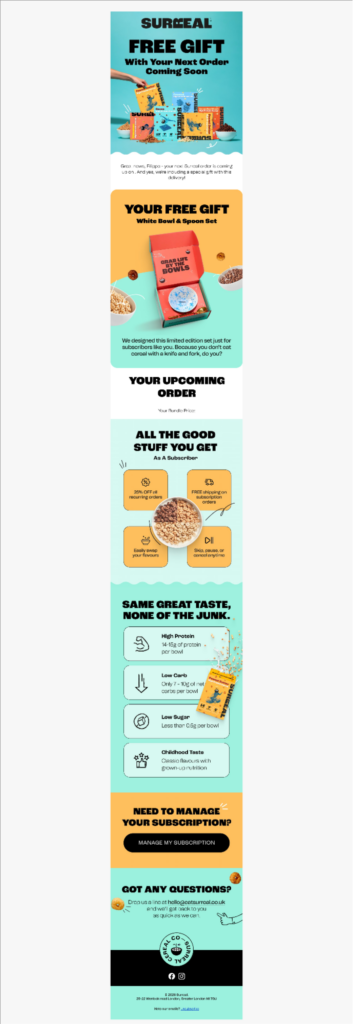
Upcoming charge reminder
The single most underrated subscription flow. Triggered a few days before the next charge, it tells the subscriber what is coming, when, and how to change it.
Send it 3 to 5 days before the charge. The point is to give people time to skip, swap, change frequency or update their address before they get billed for something they did not want.
This feels counterintuitive. You are reminding people they are about to be charged, which sounds like an invitation to cancel. It is the opposite. A surprise charge is one of the most common reasons for a chargeback and an angry cancellation. A reminder that makes skipping easy builds the trust that keeps the subscription alive, and it moves cancellations to a skip, which keeps the subscriber on the books.
Set this to transactional so it reaches everyone, and include direct links to the customer portal so the actions are one click
Failed payment (dunning)
Most subscription churn is not people deciding to leave. It is cards expiring, cards declining, and payments quietly failing with nobody following up. This is involuntary churn, and a dunning flow is how you recover it.
Trigger it the moment a payment fails, with clear instructions to update the card. Then build a short sequence rather than a single email, because most apps retry the charge several times over a couple of weeks. Match your messaging to where the subscriber is in that retry cycle.
A practical structure:
- Immediate first email on the first failure. Soft tone: “we had trouble with your last payment, here is how to fix it.”
- A follow-up two to three days later if still unresolved.
- A final email before the subscription is cancelled, making the consequence clear.
If your app exposes the retry count or the decline reason as data, use it. A card with insufficient funds may clear on the next retry, so the tone can stay light. A hard decline (expired or cancelled card) will not fix itself, so that subscriber needs a firmer “your subscription will end unless you update this” message.
This is the highest-ROI flow most subscription brands are not running properly. Set it to transactional, get the links right, and it pays for itself fast.
The lifecycle flows that keep subscribers engaged
With billing covered, these are the flows that reinforce the value of staying subscribed.
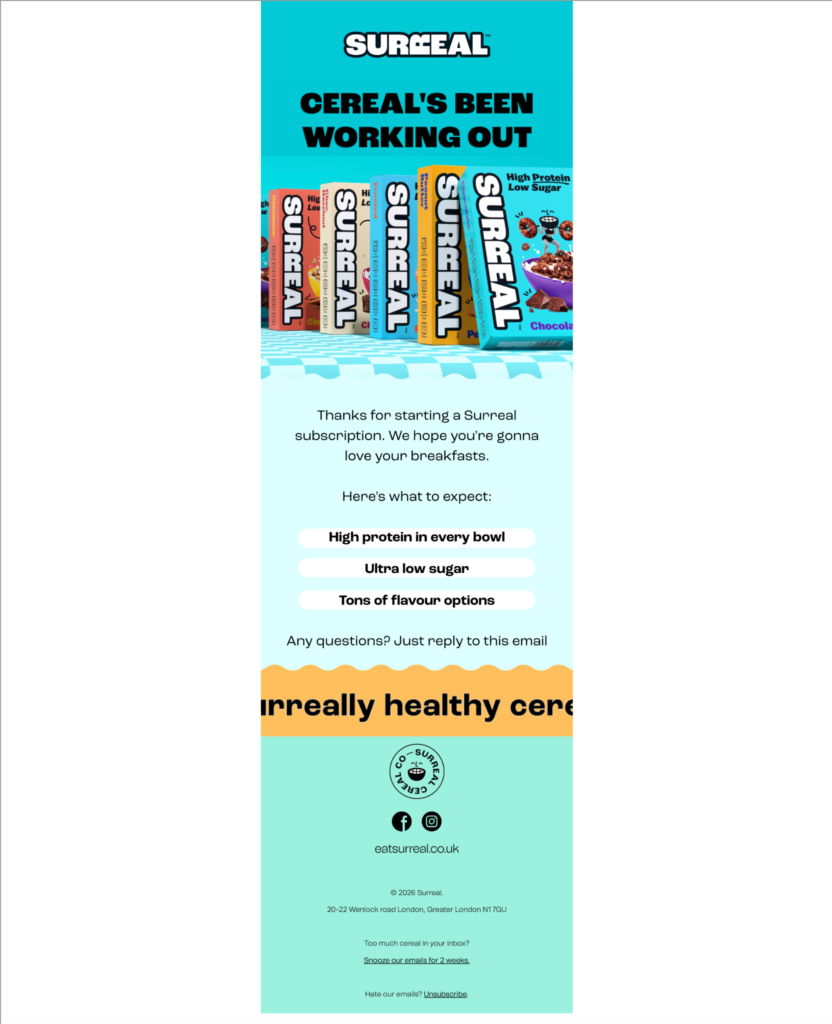
Subscription welcome and onboarding
A simple email flow that introduces your subscription program. A sequence that explains to your customers what they can expect from their subscription.
Source: Surreal
Skip, swap and pause confirmations
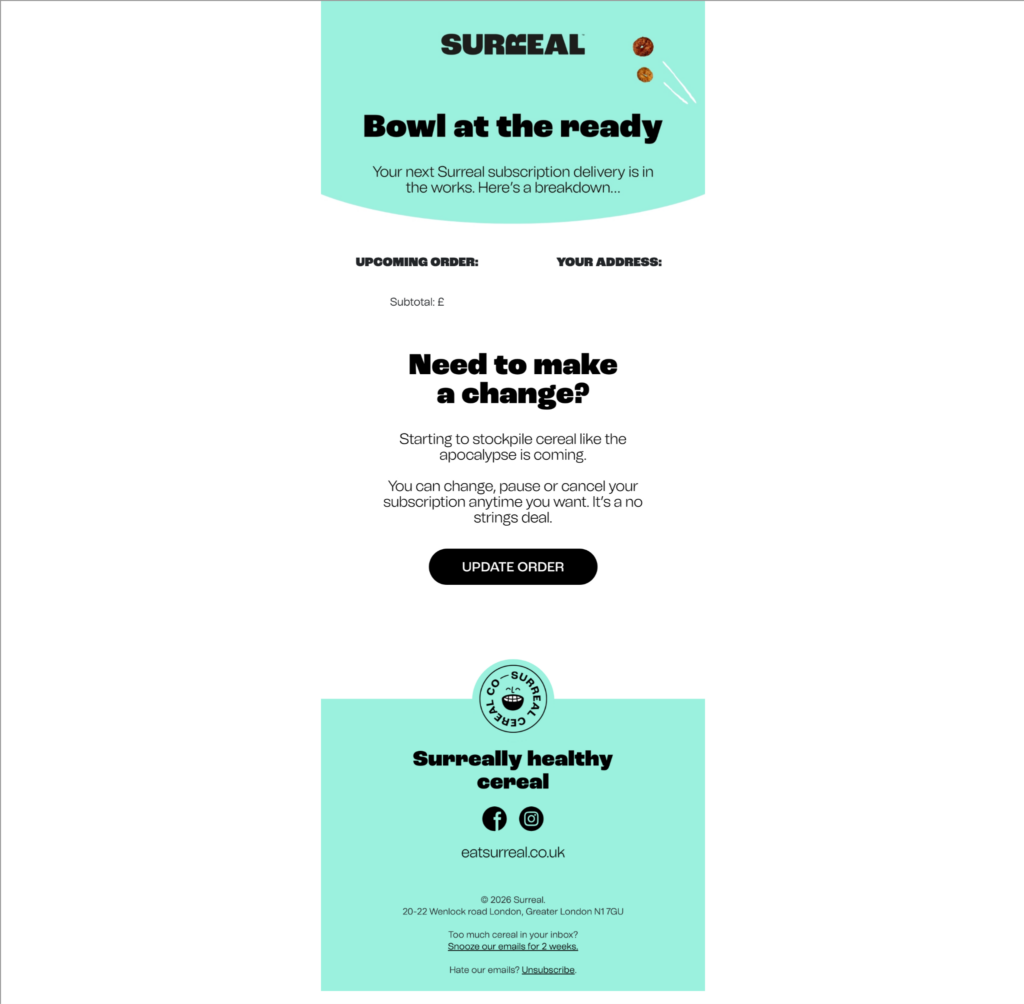
Small flows, easy to skip, but they matter. When someone skips, swaps or pauses, confirm it. It closes the loop, reduces “did that work?” support tickets, and a pause confirmation is a natural place to remind people the subscription is still there waiting for them.
A pause is not a cancellation. Treat it as a hold and time a gentle nudge before the restart.
Source: Surreal
The recovery flows for when subscribers leave
Even with the above running, some subscribers cancel. These flows decide whether that is the end.
Cancellation and save
When someone cancels, the moment is not over. Most subscription apps run their own cancellation flow at the point of cancellation with save offers (a discount, a frequency change, a product swap), and reason-routed cancellation flows retain meaningfully more subscribers than a single “are you sure?” dialog.
Know the split here. The in-app cancellation flow handles the live save attempt with offers. Your Klaviyo flow handles the follow-up: confirm the cancellation, acknowledge the reason if you have it, and leave the door open. Do not fight your app’s cancellation flow, build the email layer on top of it.
Source: Surreal
Reactivation / winback
Cancelled and paused subscribers are a warm audience. They bought the product and lived with it. Winning them back costs far less than acquiring someone new.
Target paused or cancelled subscribers with a reason to come back: a returning-subscriber incentive, a new product or variant, or simply a reminder of what they are missing. Segment by why they left where you can. Someone who paused for cost responds to a different offer than someone who cancelled over a product issue.

Source: Surreal
Priority order
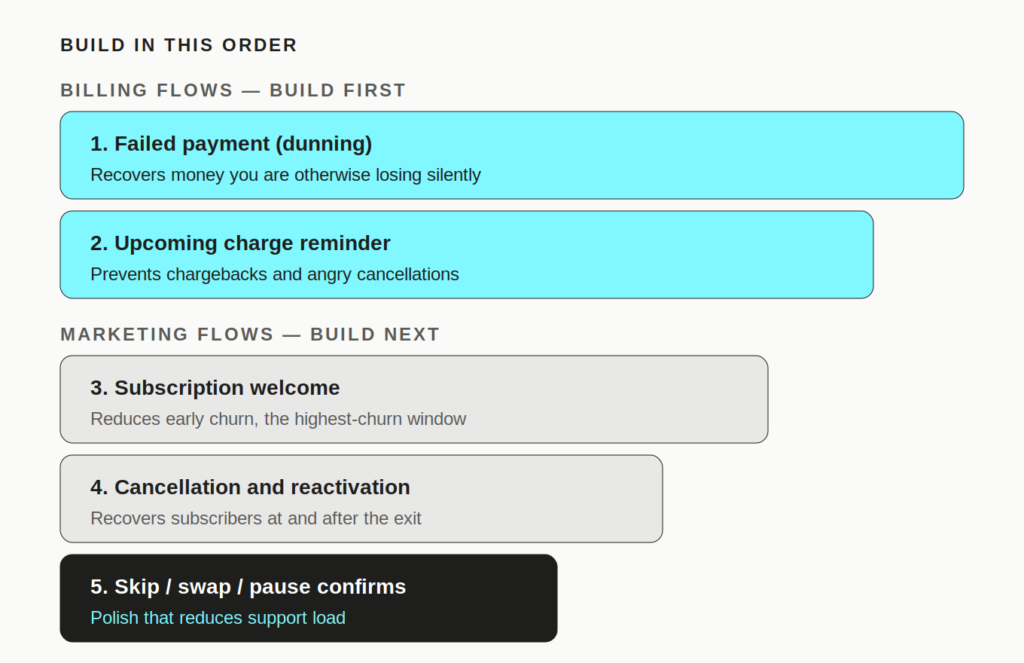
If you are building from nothing, do not build all of these at once. Build in the order that protects revenue fastest:
- Failed payment (dunning) — recovers money you are otherwise losing silently
- Upcoming charge reminder — prevents chargebacks and angry cancellations
- Subscription welcome — reduces early churn, the highest-churn window
- Cancellation follow-up and reactivation — recovers subscribers at and after the exit
- Skip / swap / pause confirmations — polish that reduces support load
The first two are billing flows, and they are first for a reason. A subscription brand that nails dunning and charge reminders before touching marketing flows will out-retain one with a beautiful welcome series and no payment recovery.
More advanced layers sit on top of this: churn-risk-triggered flows using predictive scores, milestone flows tied to renewal count (a thank-you or upsell as the third order ships), and VIP segments for your longest-running subscribers. Those are worth building once the foundation above is solid, and they depend on your app passing the right data. If you are not sure what your integration exposes or where your churn is actually coming from, that is worth a closer look before adding complexity.
Free subscription flow audit
If you want a second pair of eyes on your subscription flows, or you suspect you are losing subscribers to failed payments and silent churn, book a free 30-minute audit with us. We will look at what your app is passing into Klaviyo and where the recoverable revenue is.
Or if you want to talk through strategy first: Book a strategy call
Jamie Watkins, Director at UndergroundEcom [LinkedIn] | [UndergroundEcom.com]